Profitable Locations to Build a Padel Court in Germany
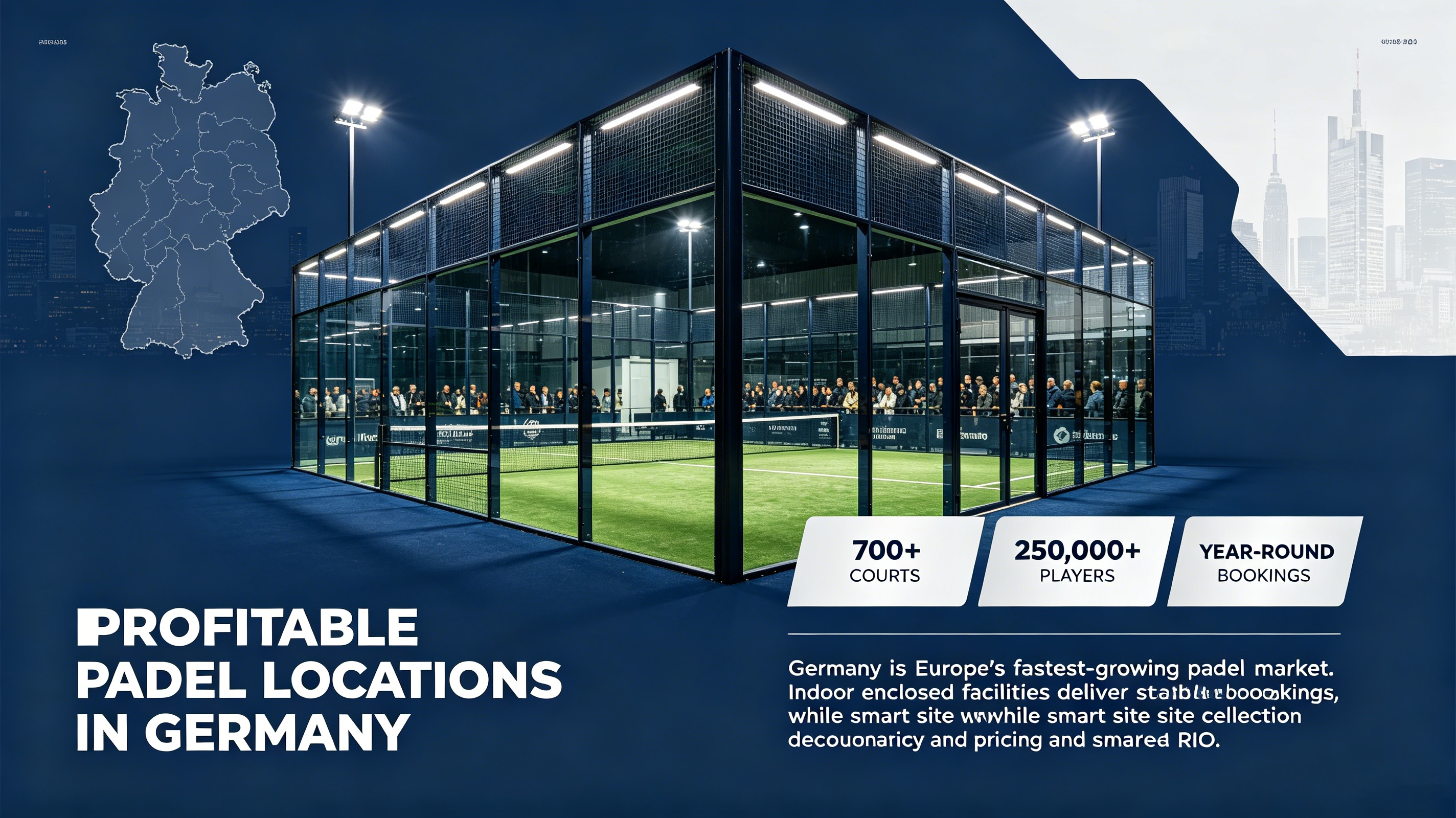
Germany has become Europe’s fastest-growing padel market, with over 700 official courts and more than 250,000 active casual and registered players nationwide.
Unlike southern European countries, Germany’s long cold, rainy climate makes indoor enclosed padel facilities the most profitable asset, guaranteeing year-round stable bookings instead of seasonal revenue fluctuations.
Site selection directly determines your venue’s occupancy rate, hourly pricing capacity, corporate cooperation opportunities and long-term ROI. Many new investors blindly build padel courts in over-saturated downtown central areas, only to face fierce competition and low profit margins.
This guide sorts out the most high-yield geographic zones, city tiers and land types across Germany, analyzing target customer groups, competitive density, rental price advantages and operational tips, helping you lock in blue-chip investment locations and maximize padel club profitability in Germany.
1. Premium High-Profit Zones: Top-Tier Major City Business & Commercial Parks
Core Advantage: High disposable income + stable weekday corporate bookings
Big German economic hubs including Munich, Frankfurt, Hamburg, Düsseldorf and Cologne are ideal for high-end indoor padel complexes, targeting office workers, enterprise management teams, international business travellers and high-income young professionals aged 25–40.
Best Sub-Locations to Choose
- Outskirts Business & Gewerbegebiete (Commercial Industrial Parks) Avoid overcrowded city centres with sky-high land rents. Choose commercial zones within 10–20 minutes from downtown, with direct highway access, abundant free parking and loose noise restriction policies. These areas are surrounded by thousands of SMEs, headquarters and tech startups, bringing massive demand for corporate team-building, regular company padel leagues and after-work social sports events. Munich Freiham Commercial District, Frankfurt Rhein-Main Business Park, Düsseldorf Media Harbour Peripheral Gewerbegebiet all rank as top investment picks, allowing you to set premium hourly rates 20%–30% higher than suburban ordinary venues.
- Airport Surrounding Commercial Districts Frankfurt Airport, Munich Airport and Hamburg Airport peripheral business zones gather numerous business hotels, logistics enterprises and international branches. Business travellers often book padel sessions for networking during short stays, filling weekday off-peak slots that most suburban venues struggle to occupy.
- Profit Tip: Build fully heated indoor padel courts equipped with lounges, catering bars and meeting function rooms to sign long-term corporate annual cooperation contracts.
2. Densely Populated Rhine-Ruhr Region (NRW): Highest Stable Cash Flow Market
North Rhine-Westphalia is Germany’s most populous state, with dense residential communities, mature sports culture and relatively moderate land costs compared to Bavaria, delivering the most predictable steady revenue for padel investors.
Top Profitable Cities & Zones
- Dortmund, Gelsenkirchen, Essen Stadium & Sports Park Surroundings The Ruhr industrial belt has a large group of sports-loving local residents, amateur sports associations and fan communities. Building padel courts near Bundesliga stadiums can combine match-day pre-event team activities, fan-themed tournaments and regional DPV (German Padel Federation) amateur leagues to maintain high weekly occupancy. Existing padel supply in peripheral sports parks is far behind local market demand.
- Cologne & Bonn Residential-Commercial Mixed Districts Located between two core cities, the connecting belt features dense high-quality residential neighbourhoods plus scattered office parks. You can develop dual customer groups: regular local resident members on weekends and corporate weekday bookings, balancing peak and off-peak revenue perfectly.
- Core Profit Edge: NRW has fewer strict residential noise limit policies than southern Germany, with shorter planning approval cycles for sports construction projects.
3. Upscale Mature Large Residential Districts (Nationwide High Repeat Customer Zones)
Family and regular local players are the foundation of long-term profitable padel clubs. High-income mature residential suburbs within 15–25 km of major cities always generate stable membership revenue, the most reliable passive income source for German padel venues.
Why These Areas Earn Steady Profits
- Target customers: middle-class families, tennis club members, local fitness enthusiasts, youth sports training participants. Most players will purchase annual or seasonal membership packages, locking in 12 months of guaranteed court bookings.
- Low competitive pressure: Many upscale suburban residential areas lack professional indoor padel facilities, and nearby tennis clubs are willing to cooperate to launch joint padel training and events, quickly accumulating stable player groups.
- Recommended Areas: West Munich upscale residential suburbs, Hamburg southern residential districts, Stuttgart peripheral villa neighbourhoods. Add junior padel academy services to capture family consumption and further boost annual profit.
4. Underrated High-Yield B-Class Mid-Sized Cities (Best First-Mover Blue Ocean Markets)
While Munich, Berlin and Hamburg have gradually become saturated with padel clubs, Germany’s tier-2 mid-sized cities represent the most profitable investment track for new investors in 2026, featuring lower land rents, weak competition, high local sports participation and rising disposable income.
Top Recommended B-Cities
- Stuttgart, Leverkusen, Regensburg: Automotive and industrial hubs with dense employee groups and mature amateur sports leagues; few professional padel centres exist locally, letting first entrants quickly monopolize regional market share and set leading pricing standards.
- Hanover, Münster, Oldenburg: Northern German emerging economic cities with abundant vacant sports land, government sports subsidy policies and strong local tennis club resources, ideal for medium-scale 4–8 court indoor padel projects with excellent return rates between 4%–5% annually.
- Investment Advantage: No fierce price competition, easy cooperation with local sports federations to host regional official padel tournaments and build regional brand influence rapidly.
5. Sports Parks & Existing Tennis/Fitness Club Expansion Zones (Low Approval Risk, Fast Customer Accumulation)
Building padel courts inside established municipal sports parks or attaching facilities to existing tennis clubs and large fitness centres is one of the safest profitable location choices in Germany.
Core Profit Advantages
- Land is pre-zoned for sports use, greatly shortening planning permission and building control approval time, avoiding land-use policy rejection risks.
- Inherit existing member resources directly: tennis players and fitness club users are the most accurate target padel customer groups, with zero customer acquisition cost in the early operation stage.
- Complete supporting infrastructure including parking, restrooms and catering is already available, cutting your initial auxiliary facility investment cost significantly.
6. Tourist Hotspot & Coastal Leisure Regions (Seasonal High-Profit Supplementary Market)
Northern German North Sea coastal areas, Bavarian alpine tourist towns and lake leisure zones deliver strong seasonal peak revenue, perfect for investors developing mixed indoor and retractable-roof padel venues.
Tourists, holiday family groups and resort corporate event teams create summer and winter vacation booking peaks, effectively improving annual average occupancy. Cooperate with local hotels and holiday resorts to launch accommodation plus padel activity bundled packages to gain stable off-season tourist flow.
Key Site Selection Rules to Guarantee High Profit in Germany
- Prioritize indoor land layout: Germany’s long cold winter determines indoor heated courts achieve 35% higher annual occupancy than outdoor-only venues.
- Parking standard: Prepare 2–3 free parking spaces per padel court; over 80% of German players travel by private car.
- Competitive density check: Avoid locations with more than 2 existing padel clubs within a 10-kilometre radius to prevent vicious price competition.
- Noise compliance: Keep venues 200 metres away from dense residential blocks to avoid strict nighttime operating hour restrictions.
- Transport accessibility: Ensure proximity to federal highways or S-Bahn stations to cover player groups within a 30-minute driving radius.
Conclusion
For maximum padel investment returns in Germany, three location strategies bring the highest profitability:
- Premium indoor padel complexes in major city peripheral commercial parks targeting corporate B2B clients;
- Medium-scale padel centres in Rhine-Ruhr densely populated districts relying on local resident membership revenue;
- First-mover padel projects in tier-2 mid-sized cities to seize blue-ocean regional market share.
- By matching your venue scale, positioning and supporting facilities to local regional consumption capacity, you can build a high-occupancy, sustainable profitable padel club amid Germany’s booming padel industry.