


All Mandatory Permits, Certifications & Documents to Open a Padel Club in Spain
Spain is the global birthplace of padel, with thousands of commercial padel centres operating across Madrid, Barcelona, Valencia, the Costa del Sol and Andalusia.
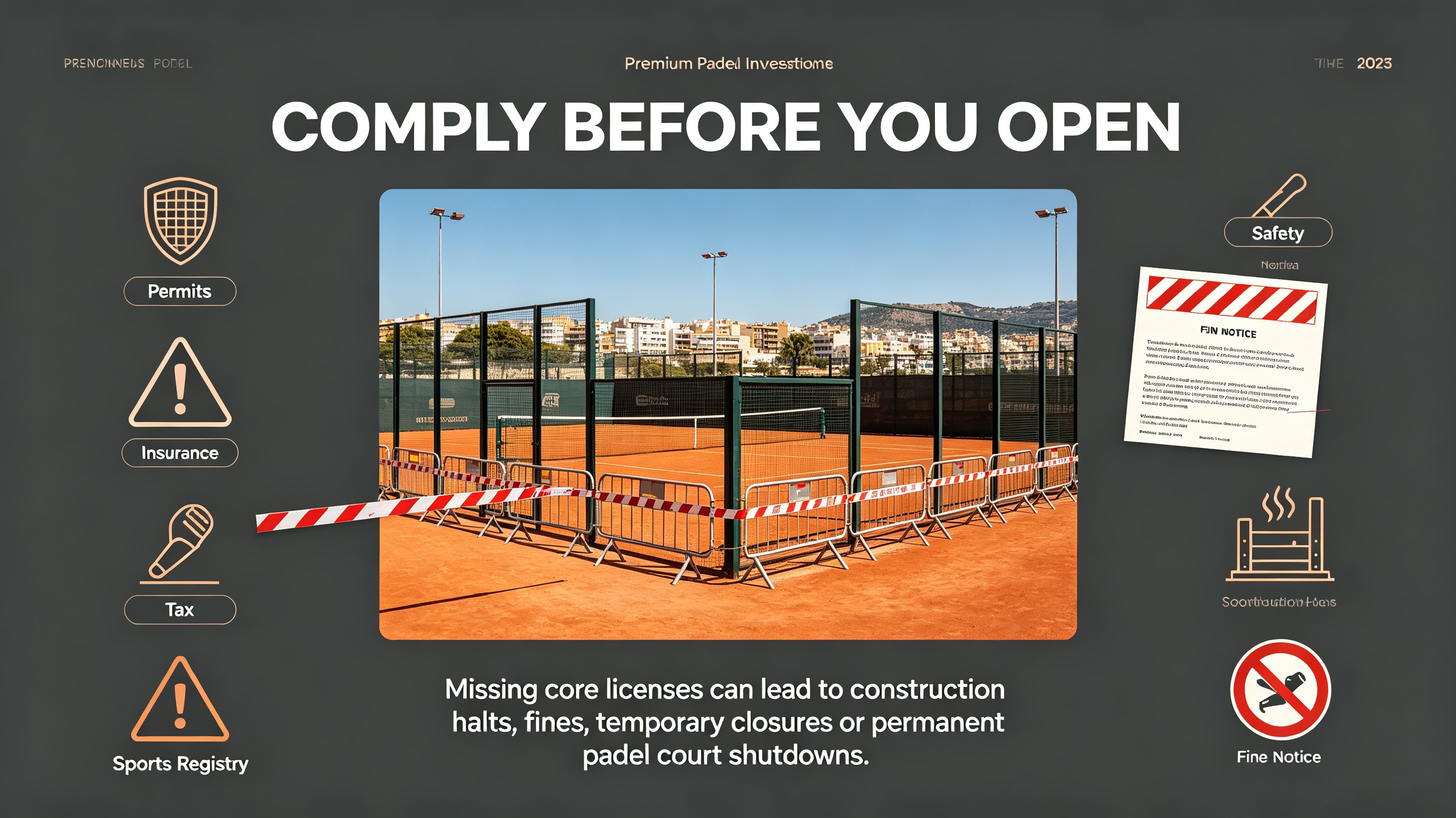
However, launching a legal, fully compliant padel venue requires a complete set of municipal, regional, national sports, construction, safety, import and business credentials. Missing any core license can lead to construction halts, heavy fines, temporary shutdowns or permanent closure of your padel courts.
This guide breaks down every compulsory qualification, permit, technical certificate and administrative document you need from pre-construction planning through daily operation.
It covers local town hall requirements, Spanish national sports standards, EU material compliance, tax registration, insurance and food & beverage add-on licenses, tailored for foreign investors and local entrepreneurs building indoor and outdoor padel facilities nationwide.
1. Business Legal & Tax Registration Documents (First Step Before Any Construction)
Before submitting town hall planning applications, you must formalise your business entity with Spanish tax authorities and commercial registries.
- Business Entity Registration & NIF Tax ID
Choose either Autónomo (sole trader) or Sociedad Limitada (SL limited company). Register via Hacienda with Model 036 / 037 to receive a unique NIF tax identification number for all invoices, VAT and import declarations. - Social Security Registration
Mandatory if you hire coaches, reception staff, maintenance or bar employees. Register for worker social security contributions to comply with Spanish labour risk prevention law. - Data Protection Compliance (LOPD-GDD Certificate)
All clubs storing member personal data, booking records and player contact details must register with the Spanish Data Protection Agency (AEPD) and maintain a valid privacy compliance document.
2. Municipal Town Hall Construction & Land Use Permits
Every padel court build (indoor warehouse conversion or outdoor open-air courts) requires official urban planning approval from your local Ayuntamiento (town council).
2.1 Building / Works License (Licencia de Obras)
Required for all groundworks, steel frame assembly, foundation pouring, indoor roof construction or major warehouse renovations. Architects submit technical blueprints proving compliance with the local PGOU General Urban Plan, land zoning rules, noise limits and environmental impact regulations.
- Outdoor courts with glass fencing and fixed posts almost always require this license across coastal and residential municipalities.
- Retractable roof or fully enclosed indoor padel complexes need full structural engineering validation alongside building license paperwork.
2.2 Opening / Activity License (Licencia de Actividad / Declaración Responsable)
This is the most critical municipal permit to legally welcome paying customers. Most Spanish cities now accept a Responsible Declaration (Declaración Responsable): you submit a signed technical project certifying full compliance with safety, fire, accessibility and hygiene rules, then begin operations pending a later council inspection.
The council will verify:
- Maximum venue occupancy calculation
- Noise insulation & acoustic impact reports
- Sanitary facilities (showers, restrooms proportional to court capacity)
- Emergency evacuation routes and fire safety layouts
- Disabled accessibility standards for public sports venues
2.3 Noise & Environmental Impact Certificate
Mandatory for padel clubs near residential zones. A licensed acoustics engineer produces an acoustic study outlining wall insulation, double-door vestibules and noise limit compliance to avoid neighbour complaints and venue suspension.
3. Technical Construction & Safety Certifications (Signed by Licensed Engineers/Architects)
All padel facilities must pass national building and sports technical standards (CTE Technical Building Code + NIDE national sports facility norms) with certified technical documentation.
- Full Technical Project Document (Proyecto Técnico)
Drawn and signed by a colegiado (registered architect or industrial engineer). Includes site plans, court dimensions, steel structural calculations, electrical schematics, drainage layouts, fire protection designs and turf foundation specifications aligned with FIP and Spanish CSD (Consejo Superior de Deportes) NIDE sports standards. - Final Construction Completion Certificate (Certificado Final de Obra)
Issued once all building works finish, confirming all materials, structures and installations match the approved technical project. Town halls require this document to finalise the Activity License process. - Low-Voltage Electrical Legalisation Certificate
Padel venues classify as public-access premises under REBT electrical regulations. All wiring must be halogen-free fire-resistant cable, and a certified electrician signs an official legalisation document for floodlights, indoor lighting, bar equipment and ventilation systems. - Fire Safety Compliance Certificate (PCI Document)
Validates fire extinguishers, emergency lighting, smoke detectors, fire-resistant structural treatments, evacuation signage and fire compartmentalisation as required by CTE DB-SI fire safety standards. - Accessibility Compliance Certificate
Confirms wheelchair access, wide doorways, accessible restrooms and zero-step entry points for people with reduced mobility, a non-negotiable requirement for all public sports businesses in Spain.
4. Import Material Compliance Certificates (If Sourcing Court Components Internationally)
If you import steel frames, tempered glass, artificial turf or LED lighting for padel courts, all products must carry EU CE marking plus full customs documentation for Spanish border clearance.
- CE Marking + Declaration of Conformity (DoC)
Mandatory for all structural steel, 12mm tempered safety glass, sports turf and IP-rated floodlights. Each product batch must hold test reports proving compliance with EN EU standards (EN 1090 steel, EN 12150 safety glass, EN 15306 sports turf). - Customs Clearance Import Documents
- Third-Party Test Laboratory Reports
Impact resistance tests for glass, corrosion testing for galvanised steel and UV stability reports for artificial turf to satisfy Spanish market surveillance inspectors.
5. Sports Federation & Regional Sports Registry Credentials
To host official tournaments, join regional padel leagues and attract competitive players, complete Spanish sports authority registration.
- Autonomous Community Sports Entity Registration
Register your padel club within your regional sports registry (Registro de Entidades Deportivas de la Comunidad Autónoma). This legalises your venue as an official sports facility recognised by regional government sports bodies. - Regional Padel Federation Club Affiliation License
Annual federation membership with your autonomous padel federation (e.g. Federación Madrileña de Pádel, Federación Valenciana de Pádel). Required to host federated tournaments, offer official player licenses and access national FEP (Spanish Padel Federation) competition circuits. - FIP Homologation Certificate (Optional Premium Upgrade)
International Padel Federation court homologation for venues wanting to host professional World Padel Tour satellite events, national championships and high-level official competitions. Verifies exact FIP court measurements, glass height, net specifications and surface performance.
6. Mandatory Insurance Policies (No Operation Without Valid Cover)
Spanish town halls and sports federations will reject your activity license application without active, sufficient insurance certificates:
- Civil Public Liability Insurance (Seguro de Responsabilidad Civil)
Core mandatory cover for player injuries, spectator accidents, property damage and third-party incidents on court grounds. Minimum coverage limits set by regional sports authorities. - Employer’s Liability Insurance
Compulsory for any venue hiring full/part-time coaches, bar staff or maintenance personnel, covering workplace accidents and employee injuries. - Building & Material All-Risk Insurance
Covers structural damage from storms, fire, vandalism or glass breakage, highly recommended for outdoor padel courts exposed to Mediterranean wind and hail.
7. Extra Licenses If Adding On-Site Bar, Restaurant or Retail
Most profitable Spanish padel clubs integrate catering, bars and pro shops — each requires separate municipal permits:
- Hospitality Activity License (Licencia de Hostelería)
Required for serving alcohol, tapas, coffee and food on-site, including terrace outdoor seating permits for post-match social zones. - Food Handling & Sanitary Certificate
All kitchen/bar staff must hold official food manipulation training certificates, with regular local health inspector audits of storage, hygiene and waste disposal systems. - Retail Commercial License for On-Site Pro Shop
To sell rackets, sportswear, balls and accessories, register retail activity with your town hall and update your tax NIF for commercial sales VAT.
8. Recurring Annual Renewal Documents
Many credentials are not one-off approvals and must be renewed yearly to avoid legal risk:
- Federation club affiliation license
- Civil liability insurance policy
- Fire extinguisher and safety equipment inspection certificates
- Acoustic compliance update reports (for high-occupancy tournament venues)
- Data protection AEPD compliance review
Final Compliance Checklist Summary for Spanish Padel Investors
- Business & tax registration (NIF, Social Security, LOPD data protection)
- Municipal building works license + Activity / Responsible Declaration permit
- Fully signed technical project + construction completion certificate
- Electrical, fire safety, accessibility and acoustic engineering certifications
- CE marking & import customs paperwork for overseas court materials
- Regional sports registry entry + padel federation club affiliation
- Mandatory civil liability and employer insurance policies
- Additional hospitality licenses if operating bar/restaurant catering zones
- Skipping technical certification or municipal permits is the most common costly mistake for new padel operators in Spain. By securing all required qualifications before construction and opening, you avoid shutdown risks, qualify to host official tournaments, and build a fully legal, revenue-stable padel club in Spain’s competitive domestic padel market.