




Import Compliance & Required Licences to Build a Commercial Padel Club in Australia
Australia’s padel industry continues its rapid expansion in 2026, reaching 90,000+ active players nationwide with more than 180 commercial padel courts operating across NSW, Victoria, Queensland and Western Australia. Demand far exceeds supply in metropolitan hubs, pushing new investors to source prefabricated padel court frames, tempered glass, artificial turf and lighting systems from overseas manufacturers.
However, 37% of first-time padel developers face costly delays, port cargo holds or council rejection due to incomplete import documentation, missing Australian standard certifications, or failure to secure mandatory local planning and operational permits. Industry cost data shows import compliance errors can add AUD 8,000–25,000 in unexpected expenses per court, while rejected development applications can push project timelines back by 6–12 months.
This guide breaks down two critical sections: full import rules and required documents for overseas padel court materials, and all local council, safety and business licences needed to construct and legally run a padel club. It includes real-world cost benchmarks, mandatory Australian standards, common compliance pitfalls and actionable checklists for investors in Sydney, Melbourne, Brisbane, Perth and regional Australia.
Part 1: Import Rules, Documentation & Certifications for Padel Court Materials
Nearly all complete padel court systems are imported as prefabricated steel frames, safety glass panels, artificial turf and hardware. Australian Border Force (ABF) and local councils enforce strict rules; generic CE certificates from Europe alone are not sufficient for Australian construction approvals.
1.1 Mandatory Business Registration Before Importing
- Valid Australian Business Number (ABN)
Required to lodge import declarations, claim GST credits and engage customs brokers. Overseas suppliers cannot act as the importer of record. - Licensed Customs Broker
Recommended for all container shipments. 82% of padel developers use brokers to avoid declaration errors. A typical broker fee ranges AUD 200–350 per sea container.
1.2 Required Shipping & Customs Clearance Documents
All consignments valued over AUD 1,000 require a Full Import Declaration (FID):
- Commercial Invoice (detailed HS codes, FOB value, material specifications)
- Packing List
- Bill of Lading (sea freight) or Air Waybill
- Certificate of Origin (critical for ChAFTA China-Australia FTA duty concessions)
- Material safety certification reports (glass, steel, turf)
- Authority Letter of Appointment for customs broker
Tax & Duty Cost Benchmarks (2026)
- Standard import duty: 5% on FOB value; 0% duty available with valid ChAFTA Certificate of Origin
- Import GST: Flat 10%, calculated on (FOB value + freight + insurance + duty)
- Port handling, quarantine and transport charges: AUD 600–1,200 per container
Example for one full outdoor padel court shipment (FOB AUD 32,000):
Without ChAFTA: Duty AUD 1,600 + GST applied on total landed value
With ChAFTA certification: Duty eliminated, only 10% GST payable
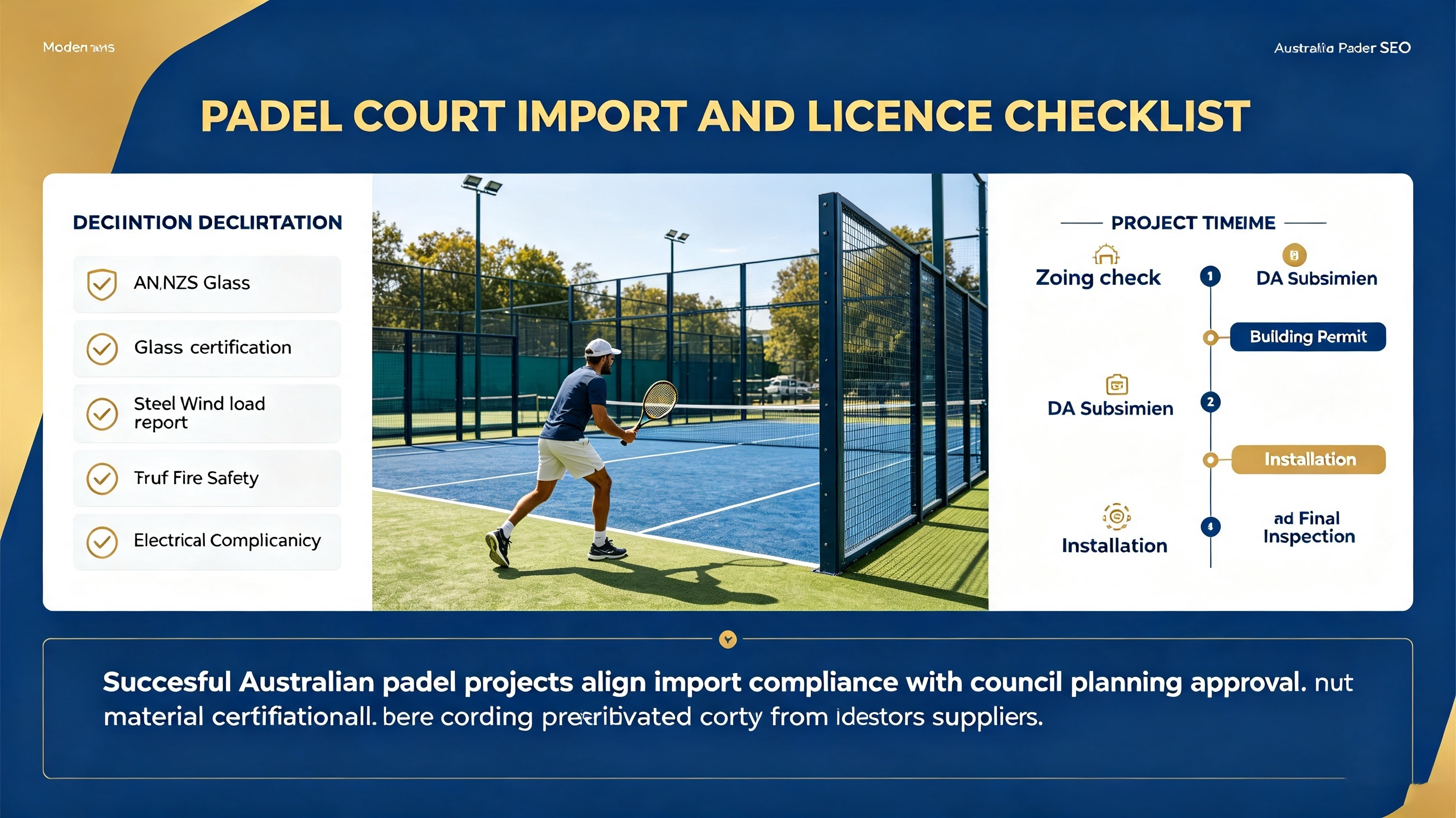
1.3 Non-Negotiable Australian Standards for Imported Padel Court Components
Councils and structural engineers will reject imported courts without these compliance certificates:
- Safety Tempered Glass (AS/NZS 1288 & AS 2208)
Minimum 12mm tempered glass; every panel must carry permanent certification marking. Uncertified glass is the #1 cause of import cargo holds and building permit refusals. - Galvanised Steel Frame (AS 4100 Steel Structures, AS 1170.2 Wind Load)
Structural drawings must be stamped by a locally registered Australian structural engineer to prove compliance with regional wind classifications (coastal zones require higher wind-load ratings). - Artificial Padel Turf
UV stability testing reports for Australia’s harsh sunlight; fire safety certification for indoor venues. - Sports Lighting (AS/NZS 3000 Electrical Standard)
All imported floodlights must meet Australian electrical safety requirements; non-compliant lighting cannot be connected to mains power.
1.4 Common Import Risks That Delay Padel Projects
- Importing glass without AS/NZS test reports → ABF detention at port
- Missing ChAFTA paperwork → forced to pay full 5% import duty
- Undervaluing goods on invoices → ABF audits, fines and backdated tax charges
- Ordering low-thickness glass (below 12mm) → engineer refuses sign-off for construction
- No pre-approved structural wind calculations → council rejects development application
Part 2: All Licences, Approvals & Qualifications to Build & Operate a Padel Club Australia
Approvals follow a strict sequence: Planning Approval → Building Permit → Safety Compliance → Ongoing Business Registrations. Requirements vary slightly by state council, but this framework applies nationwide.
Tier 1: Pre-Construction Council Development Approvals (Most Time-Consuming)
- Development Application (DA) / Planning Permit
Submit to local council, including: - Building Permit
Required for permanent padel court structures. Must include: - Geotechnical Soil Report
Required for most greenfield sites to confirm foundation bearing capacity; adds AUD 3,000–8,000 per site if ground conditions require engineered footings.
Tier 2: Mandatory Post-Construction & Operational Compliance
- Work Health & Safety (WHS) Compliance
As a PCBU (Person Conducting Business or Undertaking), you must maintain: - Commercial Business Registration
ABN, tax file registration, and if hiring staff, WorkCover insurance for all employees. - Additional approvals for extended or unmanned hours
If planning late-night / unmanned access, many councils require updated security plans, enhanced CCTV and modified public liability insurance.
Tier 3: Optional but Recommended Registrations
- Padel Australia affiliated membership (supports tournament hosting, marketing and industry networking)
- Liquor licence (if planning bar or beverage sales to boost secondary revenue)
- Food business registration (if offering café, snacks or catering)
Part 3: State-by-State Quick Compliance Differences
- NSW / Victoria: Strict noise impact requirements; outdoor courts near housing face tight operating hour limits
- Queensland & WA: Higher wind load standards for coastal sites; anti-corrosion specifications for steel frames
- Regional Councils: Less competition, but fewer experienced engineers familiar with padel court design; allow extra time for DA assessment
Part 4: Step-by-Step Project Timeline for Import & Construction
- Complete site due diligence & confirm zoning suitability (2–4 months)
- Source overseas padel supplier and request full Australian standard test reports
- Engage local structural engineer to review imported court drawings (4–6 weeks)
- Lodge council DA; wait for approval (3–9 months depending on council)
- Place order for court materials; arrange ChAFTA documentation
- Container shipment, customs clearance and local delivery
- Secure building permit, complete installation, final inspection
- Register WHS systems, activate insurance and open for bookings
Part 5: Top Mistakes Australian Padel Investors Make
- Sourcing cheap imported courts without requesting AS standard certification upfront
- Submitting DA without noise and lighting reports, leading to automatic rejection
- Underestimating landed import costs (ignoring duty, GST, port and local transport fees)
- Choosing residential-zoned land without checking noise curfew restrictions
- Skipping independent structural engineering review of imported prefabricated frames
Conclusion
Launching a profitable padel club in Australia requires mastering two parallel compliance streams: import regulation for overseas court materials, and local council construction and operational licences.
When importing padel frames, glass and turf, always confirm AS/NZS safety certificates and secure ChAFTA origin documents to minimise import duty. For site approvals, start with a zoning check, prepare noise and lighting impact reports, and engage an Australian structural engineer before ordering any overseas equipment.
Failure to align import specifications with Australian building standards creates costly delays, while incomplete council applications can stall projects for months. Investors who build compliance into their initial budget and timeline are far more likely to open on schedule and avoid unexpected fines, cargo holds or forced redesigns amid Australia’s fast-growing padel market.