



Neighbouring Businesses & Facilities to Boost Revenue for Padel Clubs in Romania
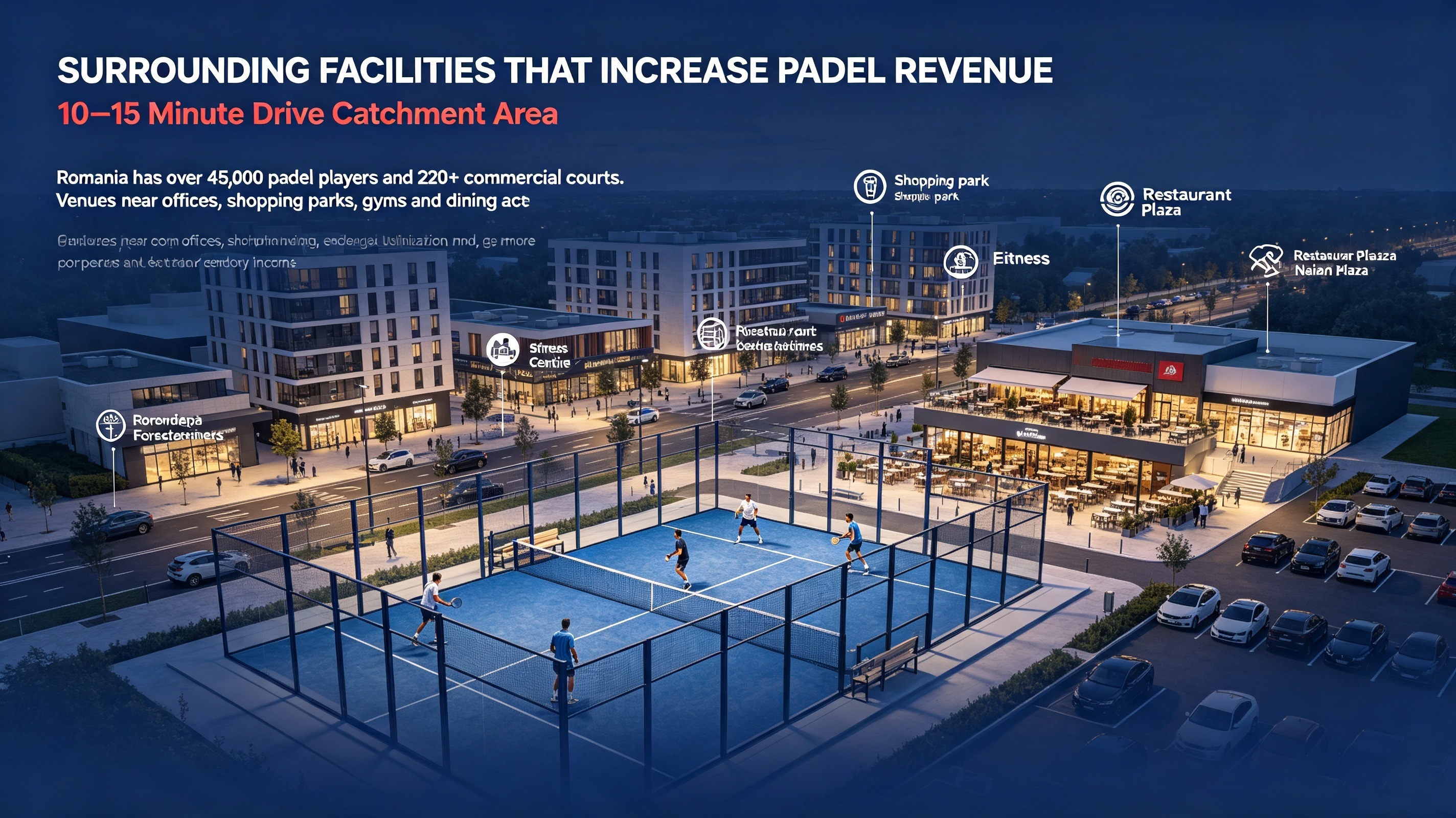
Padel continues its explosive growth across Romania in 2026, with more than 220 operational padel courts nationwide and over 45,000 active players, concentrated in Bucharest, Cluj-Napoca, Timișoara, Brașov and Constanța. Demand consistently outpaces supply in major cities, creating strong investment opportunities for new padel venues.
Many new operators focus only on court construction and pricing, ignoring a decisive profitability factor: what businesses and infrastructure sit within a 10–15 minute drive radius. Eastern European padel industry data shows venues positioned near high-value complementary amenities achieve 20%–33% higher annual court utilisation, attract more corporate team-building bookings, grow repeat member numbers and lift secondary income (coaching, F&B, pro shop sales) by up to 27%.
Isolated venues without supporting surrounding facilities struggle to fill quiet midday slots, rely purely on weekend casual players and require far longer timelines to reach positive cash flow.
This guide ranks neighbouring facilities by revenue impact, includes Romania-specific market benchmarks, city-level location advice and common site-selection mistakes for padel investors.
Part 1: Tier 1 Highest-Impact Neighbouring Facilities (Top Priority During Site Hunting)
1. Office Parks & Corporate Business Districts (Highest ROI for Romanian Cities)
Revenue Impact Data: Boost weekday evening occupancy by 25%–33%; corporate team-building packages become a reliable off-peak revenue stream.
Why it works:
Romanian office workers actively search for after-work social sports between finishing work and returning home. Tech firms, financial services, logistics companies and multinational businesses regularly organise padel tournaments, wellness events and recurring corporate leagues.
Target catchment: Within an 8–12 minute drive.
Best cities: Bucharest Pipera, Cluj-Napoca business zones, Timișoara industrial office parks, Brașov commercial districts.
Investment Tip: Contact company HR departments before opening to lock in pre-launch corporate partnerships.
2. Shopping Parks & Large Retail Centres (Prominent Traffic Source)
Revenue Impact Data: Increase casual weekend foot traffic by 21%–26%; build continuous local brand visibility.
Why it works:
Retail parks such as Coresi Shopping Resort Cluj, ParkLake Bucharest attract thousands of suburban families and shoppers daily. Visitors can easily add padel sessions to weekend errands. Most retail parks offer large shared parking, a critical advantage for padel venues.
Preferred format: Outparcel land within established shopping park boundaries, not isolated standalone stores.
Critical check: Confirm shared parking access for peak Saturday and Sunday demand.
3. Fitness Centres, Tennis Clubs & Multi-Sport Complexes
Revenue Impact Data: Lift new player conversion rate by 19%–24%; steady pipeline of sport-minded beginners.
Why it works:
Gym members and tennis athletes maintain active lifestyles and adapt quickly to padel. Existing sports venues create natural cross-promotion opportunities for joint events, beginner clinics and membership bundles.
Important Warning: Avoid direct proximity to large competing racket sports venues without formal partnership agreements.
4. Major Arterial Roads & Highway Access Points
Revenue Impact Data: Expand your effective catchment zone by 38%; attract players from multiple suburban districts.
Why it works:
Nearly all Romanian padel players travel by private car. Easy highway access allows you to draw customers from wider suburbs instead of only immediate neighbourhoods. Most successful indoor padel venues in Romania are positioned close to main ring roads.
Requirement: Ensure wide entry roads and sufficient permanent parking space.
Part 2: Tier 2 Strong Secondary Amenities (Stable Supplementary Traffic)
1. Restaurants, Bistros, Breweries & Casual Dining Plazas
Revenue Impact Data: Extend social league activity and tournament visitor dwell time, supporting late-night bookings.
Padel is inherently social. Groups commonly plan meals or drinks before or after matches. Venues close to dining attract more weekend friend groups and post-game social events, especially in Bucharest and Cluj.
2. Hotels & Business Accommodation
Revenue Impact Data: Deliver consistent weekday casual bookings for business travellers; strongest performance in tourist cities.
Perfect for: Constanța coastal zones, Brașov mountain tourism areas, central Bucharest.
Limitation: Hotel-driven traffic drops sharply in winter for non-coastal, non-ski regional cities.
3. Premium Residential Neighbourhoods & Modern Apartment Complexes
Revenue Impact Data: Build a stable recurring member base, reducing reliance on one-off casual bookings.
Ideal for suburban mixed-use padel venues targeting weekly social leagues.
Risk Note: Pure residential zones often enforce strict noise limits; many councils force outdoor courts to close by 21:00, cutting off peak late-evening revenue.
4. Universities & Private Sports Academies
Revenue Impact Data: Fill off-peak daytime slots with student discounted bookings and junior padel programmes.
Great for Cluj-Napoca, Bucharest, Timișoara university districts; student demand peaks during academic semesters.
Part 3: Tier 3 Minor Beneficial Facilities (Bonus Convenience, Not Primary Traffic Drivers)
- Pet-friendly public parks
- Gas stations and convenience stores
- Physical therapy clinics and wellness centres
- Car dealerships
These improve location convenience for existing players but cannot independently generate enough traffic to sustain a padel club.
Part 4: Areas & Land Uses to Avoid When Searching for Padel Venue Land
- Remote rural zones with no offices, retail or residential density
Insufficient population to reach profitable occupancy levels, even with low rent. - Heavy industrial zones occupied only by manufacturing factories
Factory shift schedules rarely align with padel peak play hours (17:00–22:00), creating minimal audience overlap. - Dense quiet residential-only neighbourhoods
Strict noise regulations, limited parking and high risk of resident complaints. - Flood-prone land or protected green areas
Long permitting delays and expensive site remediation costs.
Part 5: City-Specific Location Strategy for Romania
Bucharest & Cluj-Napoca (High-Density Urban Markets)
Prioritise office parks, retail shopping parks and main ring road access. Focus on corporate wellness packages and premium memberships. Indoor covered courts are strongly recommended for year-round revenue stability.
Timișoara, Brașov (Mid-Sized Regional Cities)
Balance corporate office districts and residential retail plazas; invest in outdoor courts with retractable roofs to extend the playing season.
Constanța & Coastal Towns
Combine dining areas, hotels and tourist infrastructure; prepare for strong summer seasonal demand and quieter winter occupancy.
Part 6: Common Costly Mistakes for Romanian Padel Investors
- Selecting cheap industrial land completely isolated from offices, retail and dining
Low rent cannot offset weak traffic; many remote venues fail to hit 50% annual utilisation. - Overestimating tourist traffic in inland cities
Hotels and tourist amenities deliver almost no bookings outside Brașov and coastal Constanța. - Ignoring parking competition
Locating next to fully occupied retail plazas without reserved parking creates player frustration during peak weekends. - Choosing residential zoning without verifying noise curfews, losing the most profitable evening booking window.
Conclusion
When scouting locations for a commercial padel club in Romania, prioritise sites within a 10–15 minute radius of office parks, large shopping parks, fitness centres and easy arterial road access. These Tier 1 complementary facilities reliably lift court utilisation, generate steady corporate bookings and boost secondary revenue by 20%–33% compared to isolated venues.
If operating in tourist hubs such as Constanța or Brașov, nearby hotels and restaurants become powerful secondary traffic sources. For university cities like Cluj-Napoca, student-focused partnerships help fill quiet daytime off-peak slots.
Evaluating surrounding amenities is not a secondary check — it is essential to your financial forecast. Pairing affordable land rent with a surrounding ecosystem of compatible businesses creates a continuous traffic pipeline, accelerates profitability and builds long-term resilience amid Romania’s fast-growing padel market.